
King's Mosque (Xhamia e Mbretit), Berat
The King's Mosque, known in Albanian as Xhamia e Mbretit and also called the Sultan's Mosque, is a late 15th-century Ottoman mosque completed in 1492 and set in Berat's Mangalem quarter. Allow around twenty to thirty minutes to see the prayer hall and its painted ceiling, and treat the visit as a working place of worship rather than a museum stop.
This page covers one building: its address on Rruga Mihal Komnena, the walk from the old town, the interior decoration in plain terms, and the neighbouring mosques and citadel that sit within easy reach. Opening times change with the prayer calendar, so the reliable move is to ask at the mosque itself or at your accommodation on the day.
What the King's Mosque is and when it was built
The mosque was built by Sultan Bayezid II in the late fifteenth century and stands as one of the main mosques in Berat, forming part of an Islamic Centre complex. Its completion is dated to 1492, which places it among the city's earlier surviving Ottoman buildings.
Albania's heritage authorities recognised the building in 1948, when it was designated a Cultural Monument. That status explains why the fabric has been kept largely intact even as the surrounding quarter changed.
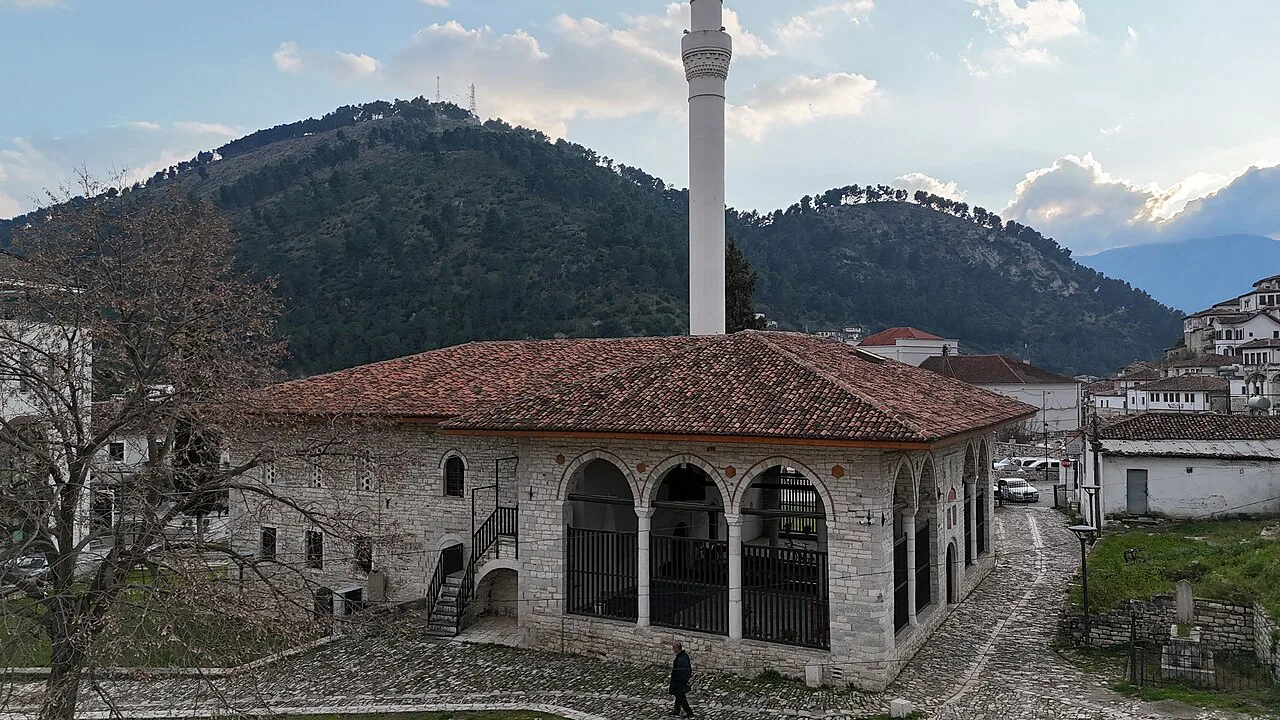
The building follows a simple Ottoman plan: a prayer hall, a porch along the entrance side and a single minaret. Knowing this helps you read the exterior before you step inside, because the porch and minaret are the two features visible from the lane.

Where it sits: Rruga Mihal Komnena in the Mangalem quarter
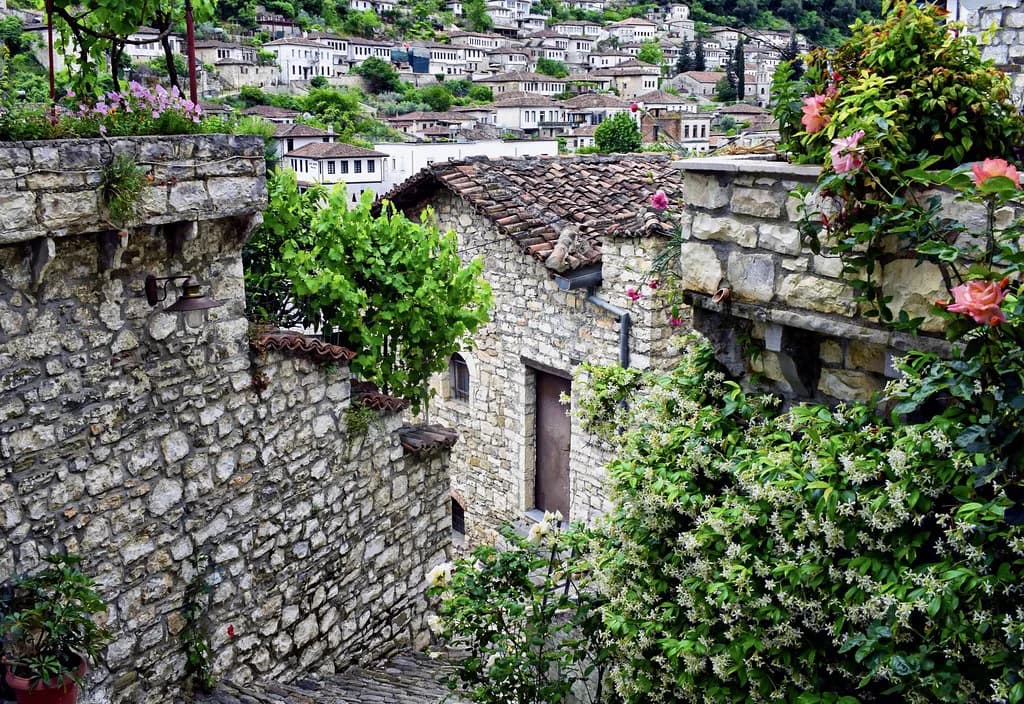
The mosque's address is Rruga Mihal Komnena in Berat, on the Mangalem side of the river. Mangalem is the quarter of stacked Ottoman houses that visitors photograph from across the water, and the mosque sits among those lanes rather than up in the citadel.
If you are working out how the town fits together, the wider set of Berat Attractions: 11 Visitor Guides explains how Mangalem, Gorica and the castle relate to one another before you start walking. The Mangalem Quarter, Berat guide is the closest companion piece to this page, since the mosque is one stop within that neighbourhood rather than a separate excursion.
How to reach it on foot from the old town and the river
Approach on foot from the riverfront: cross from Gorica via the Gorica Bridge, then climb into the Mangalem lanes towards Rruga Mihal Komnena. The streets are cobbled and stepped in places, so flat shoes matter more than a map app.
From the main boulevard side, the walk up into Mangalem is short but steepens quickly, and the lanes narrow as you climb. Leave the car below and walk; the streets around the mosque were not laid out for vehicles, and parking near the mosque itself is not something to count on.
Navigation apps place the mosque reasonably accurately, but the entrance is easy to walk past because it sits flush with the lane. Look for the minaret above the rooftops as your marker, then find the porch at street level.
What to look for inside: the painted ceiling, mihrab and pulpit
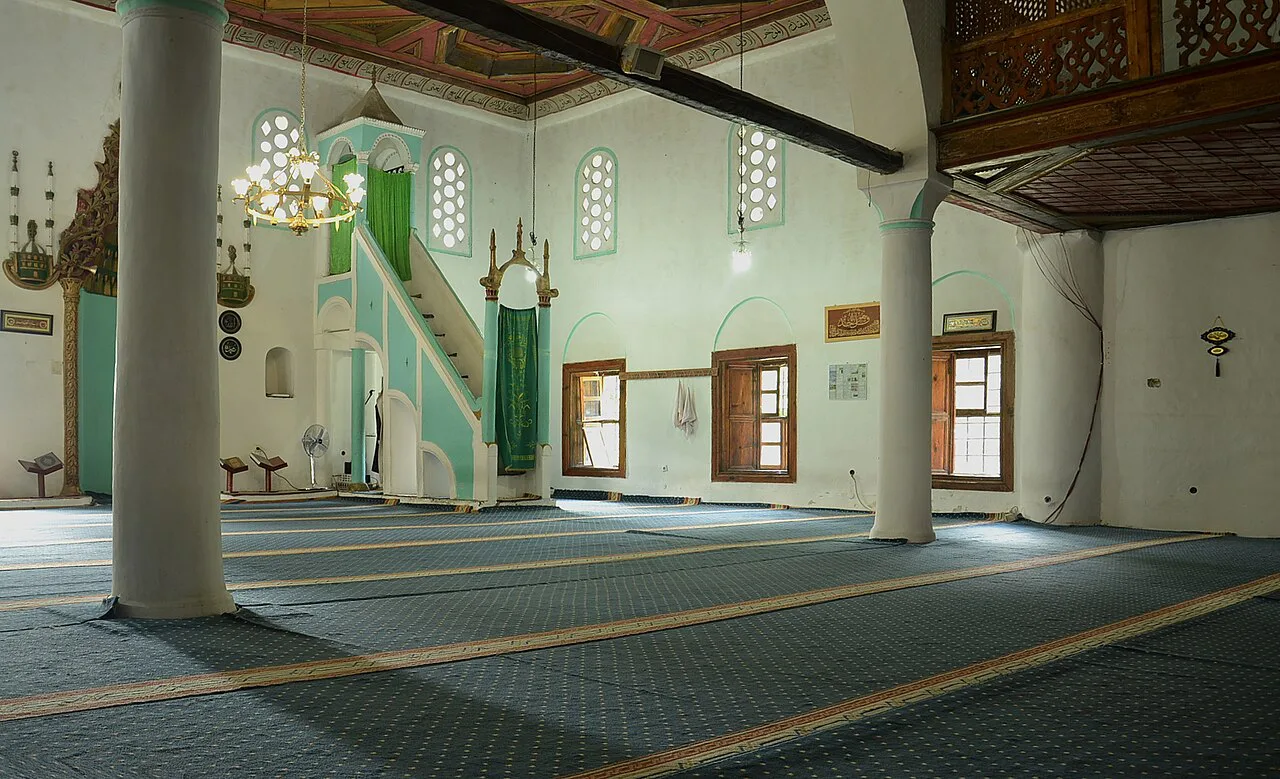
The interior is where the visit earns its time. The prayer hall has a heavily painted ceiling, with rosettes at the centre carrying inscriptions of Qur'anic sayings, and a frieze below the ceiling listing the 99 names of Allah.
At the far end, the mihrab marks the direction of prayer and is treated as part of the decorative scheme rather than left plain; the pulpit stands to the right of it. Read the three together, ceiling, mihrab and pulpit, and you have the whole decorative structure of the room.
Do not expect museum labels or a fixed route through the space. Look up, look towards the mihrab, and keep your voice low; the paintings reward quiet attention more than a quick circuit.
The minaret, porch and prayer hall layout
The minaret is the building's one vertical statement, rising from the corner of the structure and visible from much of lower Mangalem. The porch runs along the entrance front and gives shade before you step into the hall, a useful pause in summer.
Inside, the hall is a single covered volume rather than a courtyard complex, so the visit is compact. That layout is why twenty to thirty minutes is a realistic allowance even if you stop to study the ceiling inscriptions.
How much time to allow and when to go
Budget twenty to thirty minutes for the mosque itself, and rather longer if you plan to wander the surrounding Mangalem lanes afterwards. Mid-morning and late afternoon give softer light in the lanes and avoid the middle of the day in summer.
The mosque is an active place of prayer, so worshippers take priority over visitors. If you arrive and people are gathering, wait outside or come back later rather than walking through the hall; the timing of prayers shifts through the year, so ask locally rather than relying on a fixed hour.
Opening times and entry: where to check before you set out
There are no published visitor hours or entry charges for the King's Mosque, and any figure you see online is best verified on the spot. Check current opening times with the mosque directly, or with your accommodation in Berat, on the morning you plan to visit.
Because the building is a working mosque, access can be interrupted by prayer or by maintenance. Treat any visit as provisional and keep the castle as a fallback if the door is shut.

Dress and behaviour when visiting a working mosque
Cover shoulders and knees, and women should carry a scarf in case a head covering is expected at the entrance. Remove shoes before entering the prayer hall and leave them at the threshold rather than carrying them in.
Keep voices low, avoid photographing people at prayer, and do not walk across the area in front of anyone who is praying. These are ordinary courtesies in any mosque and the surest way to be welcomed rather than tolerated.
Nearby: the Halveti Tekke, the Bachelor's Mosque and the Lead Mosque
The Halveti Tekke stands close by and is often paired with the King's Mosque on a short walk through this part of town. A few minutes away, the Bachelor's Mosque, formerly the Sylejman Pasha Mosque, was built in 1928 and carries interior frescoes from the 1920s.
The Lead Mosque, also called the Izgurli Mosque, dates from the sixteenth century and takes its nickname from the lead sheeting over its dome. Seeing the three in one walk shows how Ottoman Berat layered its religious buildings across a few hundred metres.
Nearby: Berat Castle and the Red Mosque in the citadel
The King's Mosque sits below Berat Castle (Kalaja e Beratit), the walled citadel that overlooks the town. The climb up is steep and cobbled, but it puts you within the walls where the Red Mosque stands, built of red brick and limestone just outside the citadel proper within the castle.
Keep the two locations separate in your plan: the King's Mosque is a Mangalem-quarter building, while the Red Mosque belongs to the castle. Walking up the hill expecting to find the King's Mosque there is the common mistake.
Inside the castle walls, the Onufri Museum in Berat fills out a half-day if you have already seen the mosques below. Pair it with the riverside walk back through Gorica Quarter, Berat for a full circuit of the town.
Should the King's Mosque be on your Berat walk?
Yes, if you are already walking Mangalem, because it costs you twenty minutes and gives you a painted Ottoman interior that the castle's monuments do not duplicate. Skip it only if you are pressed for time and saving the hill for the castle.
Build the visit into a loop: cross by the bridge, climb to Rruga Mihal Komnena, see the mosque and the nearby tekke, then continue up to the castle. Check access on the day, dress modestly, and the rest of Berat's things to do in Berat slot in around it.
Explore more Berat guides
Frequently Asked Questions
Is the King's Mosque in Berat the same as the Sultan's Mosque?
Yes. Xhamia e Mbretit is translated as the King's Mosque and is also known as the Sultan's Mosque, a name that reflects its patronage by Sultan Bayezid II. The address is Rruga Mihal Komnena in the Mangalem quarter.
Do I need a ticket to enter the King's Mosque?
No published ticket price or visitor entry scheme exists for the building, so there is nothing to buy in advance. Ask at the mosque or at your accommodation in Berat on the day you plan to go.
How long does a visit take?
Allow around twenty to thirty minutes for the prayer hall and its painted ceiling. Add time for the lanes of Mangalem if you want to see the Halveti Tekke and the Bachelor's Mosque in the same walk.
Can non-Muslims go inside?
Visitors are generally received outside prayer times, but the mosque is an active place of worship and worshippers come first. Dress modestly, remove your shoes at the threshold and keep quiet inside the hall.