
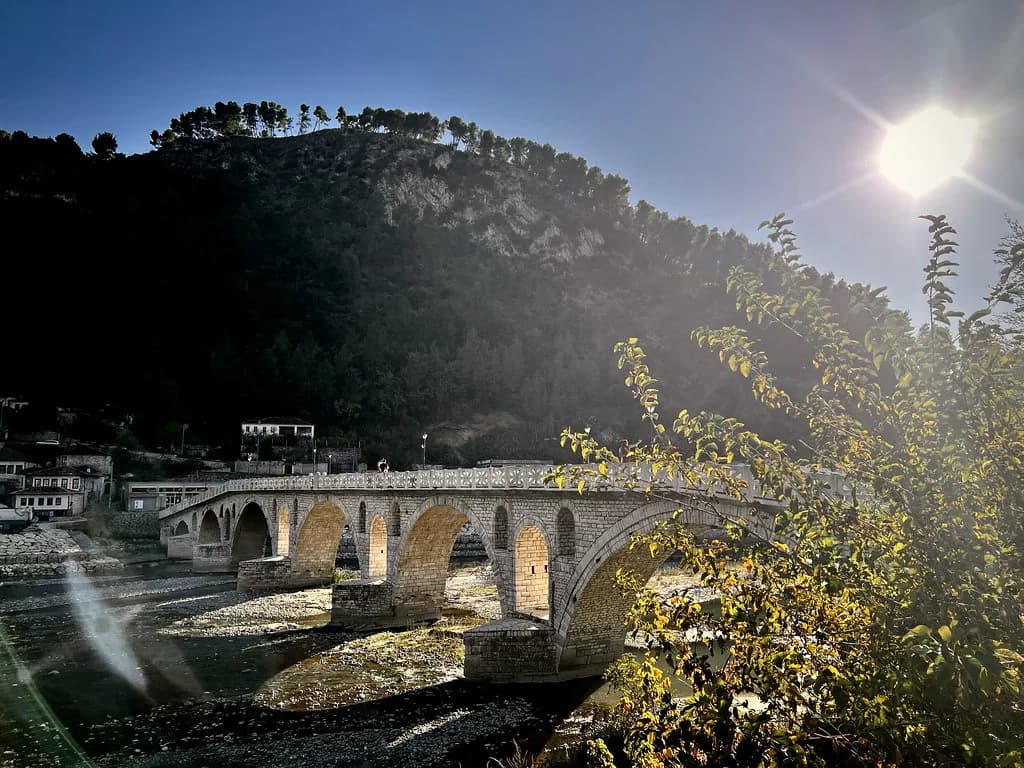
Gorica Bridge: Berat's Ottoman Bridge over the Osum
Gorica Bridge is the stone crossing over the Osum that joins Berat's Mangalem quarter on the right bank with the Gorica quarter on the left, and it takes about 20 to 30 minutes to walk across, stop for photographs and look back at both banks. It is a public crossing rather than a ticketed attraction, so it works as a sight in its own right and as the natural route into the quieter side of town. This guide covers where it sits, how to approach it on foot, what the seven arches look like up close, how long to give it and what pairs well with it nearby.
Where Gorica Bridge sits between Mangalem and Gorica
The bridge spans the Osum river, dividing Berat into Mangalem, where the Ottoman houses climb the hillside, and the traditionally Christian Gorica neighbourhood on the opposite bank. It was first built in 1780 under Ahmet Kurt Pasha, the Ottoman governor credited with shaping much of Berat's urban landscape, and it linked the two communities for trade and daily life. Seen from the middle, you get the packed houses of Mangalem on one side and the calmer lanes of Gorica on the other.
Because it stands inside the UNESCO-listed historic centre, the bridge is part of the same protected townscape as the castle and the old quarters rather than a standalone monument on the edge of town. Berat has been inscribed since 2008 as an example of Ottoman-era architecture, and both banks retain the layered churches and mosques that come with it. Treat the bridge as the hinge of a walk between the two banks rather than a stop you drive to.
How to reach it on foot from Berat's centre
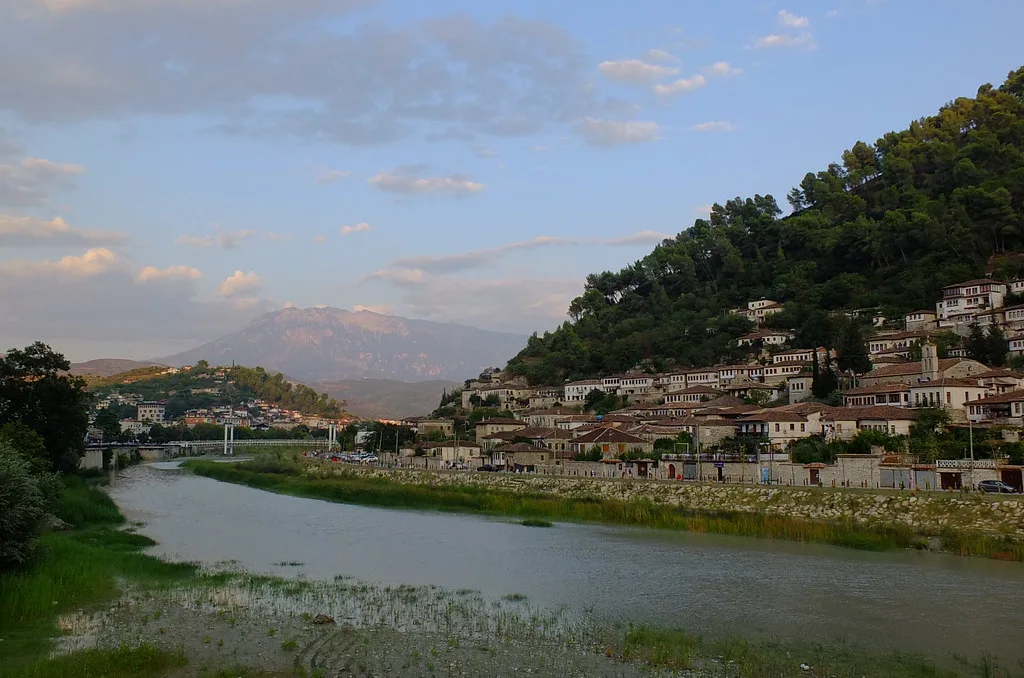
The bridge is easy to reach on foot from the city centre: most visitors start in Mangalem, follow the river down and cross into Gorica. The approach from the Mangalem side gives you the arches head-on with the Gorica houses behind them, while the Gorica side gives you the reverse view of Mangalem rising up the slope. The surrounding streets are cobbled and uneven, so tread carefully.
Wear shoes with grip rather than smooth soles, particularly after rain when the stone and cobbles polish up. If you are starting from the bazaar end of town, cross the river first and loop back through Gorica so you finish with the classic view of Mangalem from the far bank. Anyone planning a wider circuit of the old town can use the Berat Attractions: 11 Visitor Guides hub to see how the bridge fits with the castle and the museums.
What you see from the bridge: Mangalem houses, the Osum and Gorica
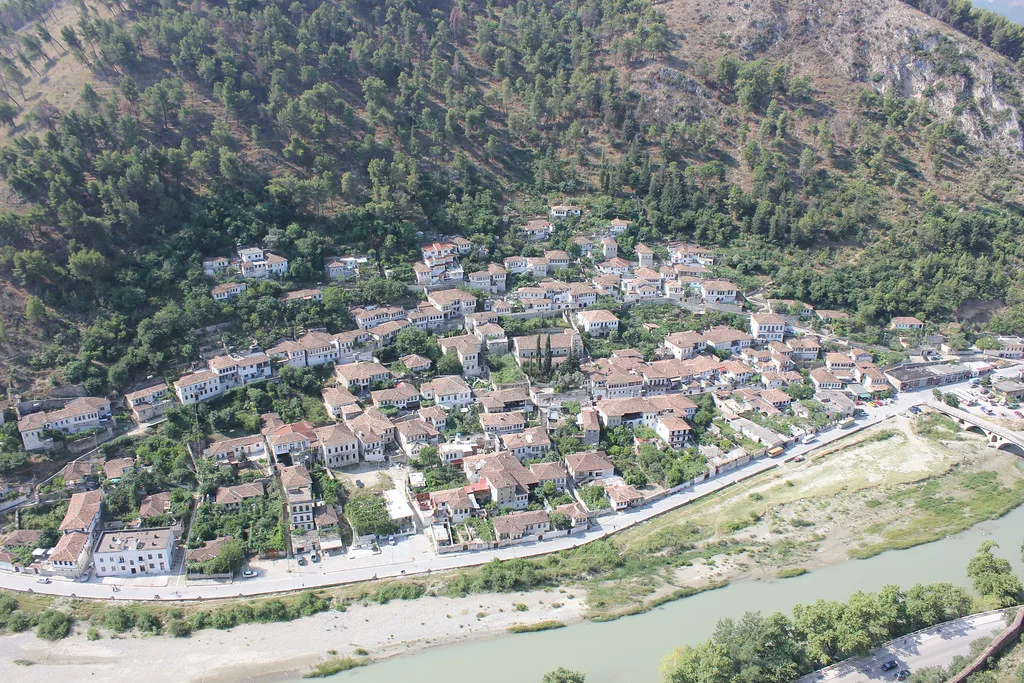
Standing on the bridge gives you the view that sells Berat: Mangalem's tightly packed Ottoman houses stacked up the hillside, the Osum running beneath, and Gorica's lower rooflines across the water. The houses on the Mangalem slope are what earned the town its thousand-windows reputation, and the bridge is one of the few places where you can take in the whole sweep in one look. Photographers should walk to the middle and look back at each bank in turn rather than shooting only from the ends.
Golden hour, when low sun catches the stone and reflects off the river, is the most rewarding time for photographs. Daylight is the better window for reading the architecture and appreciating the stonework, so decide whether you want record shots or atmosphere. Either way, the bridge rewards a slow crossing rather than a march from one bank to the other.
The seven arches and the stonework
The bridge is built of seven symmetric stone arches, about 129 metres long and 5.3 metres wide, standing some 10 metres above the average water level. It is constructed from local limestone and river stone, fitted to withstand the Osum's floods, and it was designed for carts and pack animals rather than today's foot traffic. From the banks you can see the rhythm of the arches; from the deck you can inspect the joints and the wear on the parapets.
The bridge was first built in 1780 and later rebuilt in stone, with the seven-arched stone structure that stands today carrying the name Kurt Ahmed Pasha bridge as well as Ura e Goricës. Archiqoo records a renovation in 2015, and the Albanian Development Fund restoration reported by the Tirana Times improved the bridge, its lighting and the surrounding cobbles in 2014.
How long to allow and when to come
Budget 20 to 30 minutes for the bridge itself, including a stop on each bank for photographs. Add an hour if you plan to wander Gorica's lanes, and a further two to three hours if you are combining the bridge with the castle on the hill above Mangalem. Compressing all of it into a rushed morning misses the point, since the pleasure is in the crossing and the views rather than a ticketed attraction.
The bridge is a public crossing, so it slots easily into a day rather than needing to be booked; if you are travelling specifically to see it, confirm access with your accommodation before building the day around it. In summer, do the crossing outside the hottest hours if you intend to continue up to the castle.
The story of the bridge in brief
The bridge has long been treated as a symbol of coexistence in Berat, where Christian and Muslim communities lived on opposite banks and depended on the same crossing. Local folklore attached a darker story to the original wooden structure, involving a sacrifice to protect the bridge; it is legend, not history, and is best heard from a guide rather than repeated as fact. What is documented is the bridge's practical role in moving agricultural goods, livestock and crafts into Berat's markets.
A restoration funded through the Albanian Development Fund brought the bridge, its lighting and the surrounding cobbles back into use, and it has since hosted cultural events celebrating bridges as links between communities. For visitors, this is a working historic crossing rather than a ruin behind a fence.
Crossing into Gorica: the quieter side of Berat
Gorica, on the left bank, is the calmer counterpart to Mangalem: cobbled lanes, walled courtyards and family houses rather than the dense stack of windows opposite. Crossing the bridge is the easiest way to reach it, and the neighbourhood works well for an unhurried hour of wandering after the bustle of the bazaar. The Gorica Quarter, Berat page covers which lanes and viewpoints justify the detour.
If you want more than streetscape, combine Gorica with the museums and mosques on the Mangalem side. The Bachelors' Mosque (Xhamia e Beqarëve), Berat sits near the river and is easy to fold into a walk back towards the bridge, and the Ethnographic Museum, Berat gives context on the domestic life behind those windows.
What's nearby: the castle and the old quarters
Berat Castle (Kalaja e Beratit) sits on the ridge above Mangalem and is the natural next stop after the bridge; allow two to three hours for the climb and the circuit inside the walls. Within it you will find the Onufri Museum in Berat, housed in the Church of the Dormition, along with several Byzantine churches worth a look.
On the Mangalem side, the King's Mosque (Xhamia e Mbretit), Berat and the Church of St Michael (Kisha e Shën Mëhillit), Berat sit close enough to the river to fit into the same afternoon. If you are building a fuller day, the things to do in Berat guide shows how these pieces fit around the bridge and the Osum river.
Practical points: pedestrian-only and restoration checks
The bridge is pedestrian-only, so you will not be sharing the deck with cars, and it is a public crossing rather than a gated attraction. Past restoration work improved its lighting and the surrounding cobbles, and it remains a working historic crossing rather than a ruin behind a fence.
The cobbled surface and the changes of level on the approaches make the crossing uneven underfoot, which matters for anyone unsteady on their feet. Otherwise, the crossing is short and level, making it one of the easiest historic set pieces in Berat to slot into a day.
Should you build your Berat day around the bridge?
Yes, if you treat it as the hinge of a half-day rather than a destination in itself: cross from Mangalem into Gorica in the late afternoon, wander the quieter lanes, and come back for the view of the thousand windows in low light. Combine it with the castle or the museums and you have a coherent day without rushing.
Explore more Berat guides
Frequently Asked Questions
Is Gorica Bridge free to visit?
Yes. It is a public river crossing rather than a ticketed attraction, so there is no entrance fee and no gate. You simply walk onto it from either bank.
Can you walk across Gorica Bridge?
Yes, the bridge is pedestrian-only and you cross it on foot between Mangalem and Gorica. Allow 20 to 30 minutes if you want to stop for photographs from the middle.
Why is it called Gorica Bridge?
It takes its name from the Gorica neighbourhood on the left bank of the Osum, which the bridge connects to Mangalem. Locally it is also known as Ura e Goricës and as the Ahmet Kurt Pasha bridge.
How long is Gorica Bridge?
It runs roughly 129 to 130 metres, is about 5.3 metres wide and stands around 10 metres above the average water level, carried on seven stone arches.